Tuesday, June 7, 2022

Resort Vibes

Playa Del Carmen
Resort R&R

I decided there is no way I’m going to risk injuring my leg any more with a snorkel trip, so I opted to stay at the resort today while Andrea, Sydney, and Elisabeth headed off on a snorkel trip that we had already paid for. (Catherine stayed behind as well because she wasn’t feeling well). I guess it all worked out, because about 30 minutes later everyone had returned because the snorkel trip had been cancelled due to rough waters and a murky reef.
It was nice to enjoy a full day of R&R at the resort. I wasn’t much fun as I just stayed on my lounge chair resting and icing my leg. We decided to hang out at the “old person” pool. That was the name we gave it because unlike the other pools, there wasn’t any loud music or water volleyball games going on. There also weren’t any resort entertainers trying to get the crowd to have a pool dance party. We liked the quiet and “old” people just relaxing and reading. The pool was also perfect for my leg as I could get in and walk around in the water which felt nice.

We spent all afternoon outside enjoying the all-inclusive food - we drank pina coladas, nachos, ice cream, treats, and more. For dinner we decided to eat at the resort steak house. It was in an open restaurant near the beach and had a nice breeze. I liked the ambiance. The food was OK, but the chocolate dessert was awesome! It was fun to sit around with the girls at a “fancy” dinner and just relax. I’m not a big fan of resorts - but they are convenient. We capped off our night with some card games in our hotel room. 


Monday, June 6, 2022

Mayan Temple Tour

 Playa Del Carmen

Tulum * Chichen Itza * Cenote

Our day started early with an 8:00 a.m. pick up from an LDS tour company - Alma Tours. We met our guide Luis who would be our escort for the next 12 hours.

After a comparatively short 30-minute ride to Tulum we meet up with another 8 travelers for our morning tour of this seaside Mayan town. This seaside town must have been the Riveria of the Mayan civilization back in its day. It is beautiful and has great view of the ocean. The ocean provided a natural barrier from invaders. We learned that this civilization was still habituated by the Mayans when the Spaniards arrived and conquered the country.

It was a long 2 1/2-hour drive to Chichen Itza from Tulum, but before entering the site we stopped a local roadside restaurant to authentic food. Very yummy! The spices and flavors are familiar and yet still taste foreign. Maybe because Mexico is our closest neighbor, and we eat lots of Mexican food when at home.

The guide took a very clever rout through the Chichen Itza site. We came to the main temple through a side area which made of a nice grand entrance to the large temple site. The large temple site was flat with the huge temple in the middle surrounded by buildings on most sides. It was very impressive. A total of 91 stairs up each side of the temple and 1 final step on top symbolizing the 365 days of the year. It’s amazing to think of what this temple pyramid might have looked like at its peak and interesting to think of the people that might have lived in its shadows.

We toured the main sights and tried to comprehend why human sacrifice could be such an important part of their religious traditions. One particular building had the skulls of the killed as part of the decor on the walls. Because we visited both Tulum and Chichen Itza in one day, we only visited the main complex of the site and not the outer courtyards. We probably should have skipped the cenote and stayed at the site because at the cenote, Lara jumped in (like everyone else) and pulled her hamstring - so bad that getting out of the water, and then walking back up the stairs was extremely painful and difficult. It wasn’t a reckless move on Lara’s part, but maybe something that is beyond her age at this point. Either way, it was fun in the moment but was not worth the pain of landing wrong and the risk of ruining the rest of the summer sabbatical.


Sunday, June 5, 2022

"Down in Mexico"

Playa Del Carmen 

Church * Cozumel


We did our best today to make it feel like a Sunday. We were up early, dressed and pressed, and ready for church. We took a quick 10-minute taxi ride into Playa Del Carmen and arrived at 8:50 a.m. - 10 minutes before church started. There was 1 lonely car in the parking lot. Gratefully when we walked in there were a few people in the chapel and one other family visiting from Utah. 

The meeting started on time, but a member of the bishopric showed up 15 minutes late and didn’t worry about walking to take his place on the stand, during the Sacrament song. Welcome to Mexico. It was fast and testimony meeting which made the gospel topics a bit easier to understand, except that most people are still wearing masks which made it hard to hear. It was kinda cute - as soon as the sacrament was over, people jumped to their feet and headed to the stand to share their testimonies. There was not a pause in testimonies for the entire meeting.

We decide to stay for Sunday School. We’re studying the Old Testament right now which is hard enough in English, let alone in a different language. I gave up rather quickly trying to follow along and ended up just reading a conference talk on my phone.

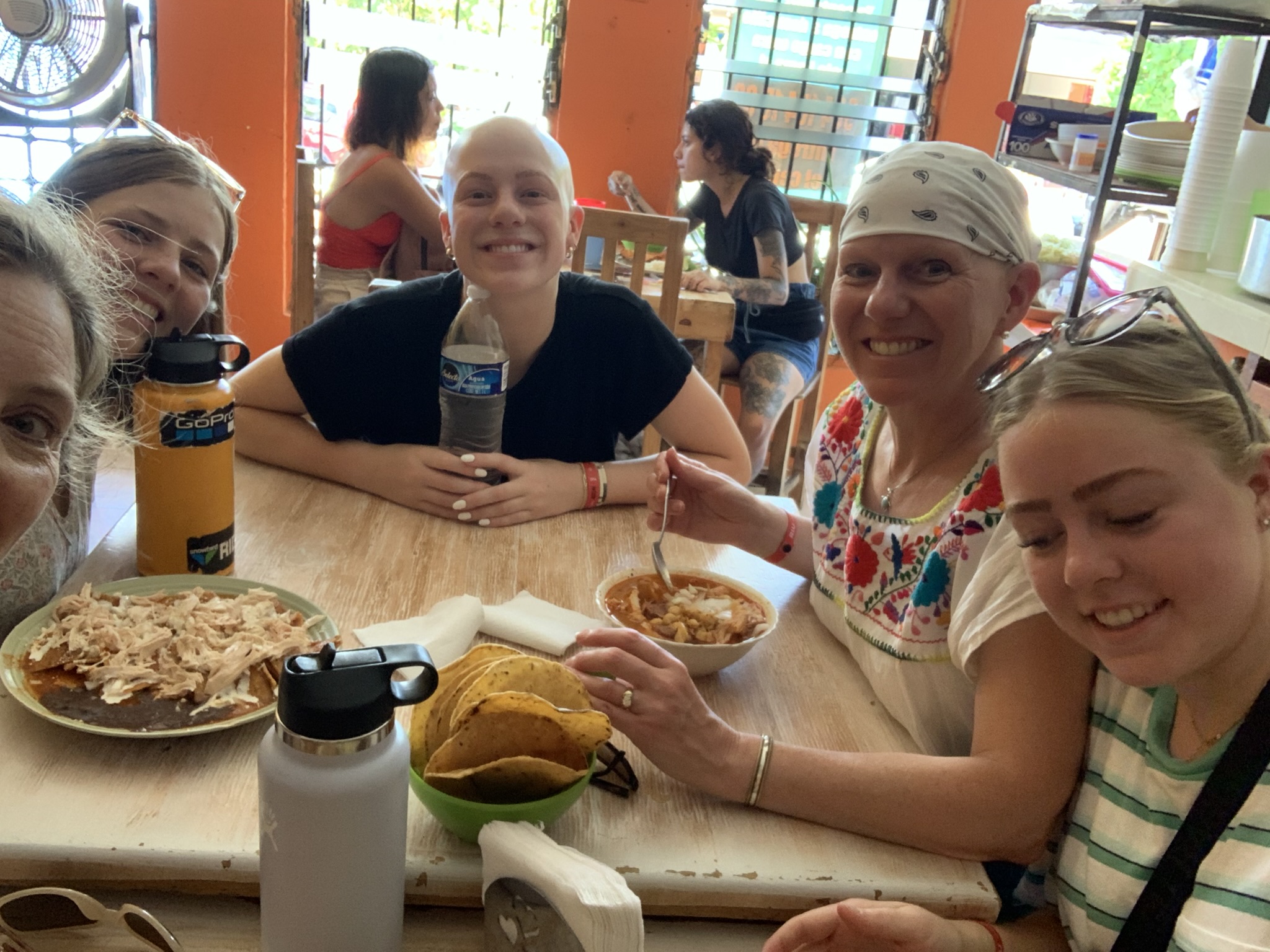
After church we decided to get adventurous and headed into Playa Del Carmen for an authentic Mexican lunch. It took some convincing of Andrea that we wouldn’t get sick (and honestly, I didn’t know if we would or wouldn’t), but we found a local dive that was perfect and yummy! I read the reviews on-line and ordered the pozole. A chicken and beef soup with pasta and beans. It reminded me of a tortilla soup back home.

We enjoyed a quick walk through the center of town down to the Ferry dock where we purchased our tickets to Cozumel and were talked into pre-purchasing our scooter rentals for the afternoon. There is a lot of commerce going on in Mexico - it’s quite honestly exhausting. I had reserved some scooters for the afternoon already, but this guy had a good sell, so I canceled my reservation and went with the salesman I met at the pier.

After a short Ferry ride to Cozumel, we made our way to the scooter rental shop and rented 3 scooters. It didn’t take long for Andrea to turn over the driving of her scooter to Catherine (such trust)! I drove our scooter with Sydney. I’m not sure I’ve ever driving a scooter before, so it was a bit intimidating maneuvering the streets to get out of town and having a passenger on the back was tricky. We probably didn’t clear 30 km/hr until we were well out of town. I also stayed in the “bike” lane for longer than I should have just to be away front the cars.

It would have been nice to have some extra time on Cozumel to stop at the beaches, swim, and explore. Rather we had a goal of circling the island so only had a few minutes to stop at the southernmost tip to use the bathroom and grab some water. There was a little “watering hole” that looked like it could have been out of a movie. I enjoyed the ride back up the eastern side of the island best. The road was more open, and I could see the ocean while we road.

We timed the ride perfectly and were back on the boat by 5:45 for our journey back to the mainland.  We were bushed and retired early tonight. Not sure why riding a scooter felt like I’d spent 2 hours on a horse, but my legs were tired.


Saturday, June 4, 2022

The beautiful beach

 Playa Del Carmen

We didn’t make any big plans for today; we knew that we would all need some R&R after a hectic last week of school and work and busy time getting all the last-minute things ready for our trip. After sleeping in and breakfast we headed to the beach. We managed to find some lounge chairs under a palm tree, but there were some little gnats that kept bothering us so we decided being by the pool would be best. Sydney and Lara took advantage of the free kayaks and headed out to the open waters to enjoy the ocean and the sun. There aren’t big waves, so we found it easy to maneuver. The pool was nice, and despite some cheesy dancers from the resort trying to get the crowd into a dance party, we enjoyed eating nachos and swimming, napping, reading, and relaxing. It was great.

After dinner ate at the Italian restaurant, we didn’t even stay up late to play games - still too tied to do much, so we went to be early.


Friday, June 3, 2022

Tired and ready for some R&R

Today official starts our summer sabbatical. Sydney and Lara are heading to Mexico for a quick senior trip and Eric and Charlie are heading to Peru tomorrow to visit some of Eric’s mission cities. Sydney rolled in last night around 3:00 a.m. after a night at the Senior graduation party and we were at the airport by 8:00 a.m. for our flight. Good thing she can sleep all day.


We arrived at our resort to check-in, have some dinner, wander around a go to sleep after a long day of traveling. We are staying at an all-inclusive resort, the Riu Yucatàn, just a couple of miles from the Playa del Carmen town. It’s nice that it’s all inclusive, it will make the vacation easier on everyone. We enjoyed a nice dinner at the “International Buffet” followed by a walk around the resort where we heard howler monkeys in the trees. They sounded like someone was dying. Luckily, we ran into some guests that explained what we were hearing.


Monday, March 25, 2019

Italy - the Big 3

Visiting Italy can be compared to stepping into your favorite gelato shop — everything looks so good and it can be hard to make a decision.  There are so many choices, all so different, and yet all so delicious.  There is something in the Gelateria, or the country of Italy,  that appeals to everyone.  And just like a good gelateria, Italy invites you back time and time again to try a new flavor.
For the first timer a visit to the “Big 3” is essential: Rome, Florence, and Venice.  But realize that because they are the Big 3, there’s a good chance that everyone else had the same great idea.  For this reason, by getting off the beaten path, even within these famous cities, you can find some hidden gems of Italy.  I’ll share my thoughts on some of these hidden gems of Rome, Florence, and Venice and save the other tastes of Italy for another time.
A first timer’s visit to Rome will likely see the Vatican Museums, Sistine Chapel and St. Peter’s Basilica as well as the sights of Imperial Rome, but let me offer a suggestion for my favorite museum in Rome, the Museo Borghese.  Nestled in the middle of the Villa Borghese, a large and beautiful city park sits the Museum Borghese, a 17th century Villa converted to a museum.  The museum houses several famous and spectacular Bernini sculptures as well as an impressive collection of art including pieces by Caravaggio, Rapheal, and Reubens.  While the Museo Borghese is popular, the crowds are well managed with a required reservation and timed entry for all visitors.  The museum is a comfortable size and the entire collection can be easily enjoyed in under two hours.  It’s a pleasant break from the city and the crowds. Afterward you can reward yourself with a nice stroll or bike ride through the massive park and finish off the afternoon at the far end of the park in the Terrazza del Pincio.  This Terrazza commands an impressive view of the city of Rome and the Piazza del Popolo below.
Florence is a quick train ride north of Rome with trains leaving hourly.  In Florence, you can walk everywhere.  From one end of the historic center to the other is only a 20 minute walk.  The city invites strolling and meandering, with traffic limited to essential vehicles only.  Of course, as a first timer, you’ll want to make time to visit Michelangelo’s most famous statute, the David, and the nearby Uffizi gallery, and marvel at Brunelleschi’s dome, but don’t stop there.  Florence is an art and history lovers paradise.  As the birthplace of the Renaissance and our modern world, it is a city from which to drink deeply.  The best way to enjoy Florence is to take advantage of the Firenze Card, your 3 day pass to the city.  Just pay attention as you plan out your visit as the museums have erratic schedules that can change in an instant and if you’re in Florence over a weekend, pay particular attention as many of the top sights are closed Sundays and Mondays.  Whatever you do, make a little time for the Bargello.  Sometimes this museum is overlooked by its flashier neighbors, but the Bargello, among other things, offers sculptures by Michelangelo and Donatello that are well worth your time.  Housed here is Donatello’s David that provided a catalyst for so many sculptures of the Renaissance period and beyond.   The building itself lends interest as it served once as a police station and a prison.
Venice is so unique that everyone should experience it at least once.  The maze of islands and canals and bridges is inviting - accept the invitation to wander - and don’t worry about getting lost, it’s a small island.  Somehow the Venetians have learned to survive in this constantly sinking and ever flooding environment.  Along with the occasional bit of water in San Marcos’ square, Venice is inundated each day with daytime visitors and cruise ships.  The crowds can be a problem and make for an unpleasant visit.  However, it doesn’t take much to find your own little nook of Venice to enjoy, just get off the main street of shops and restaurant and let yourself get lost in the back alleys and bridges.  You’ll discover a Venice that most tourists miss.  For an amazing birds eye view of the Island and San Marco’s square, take the Vaporetti (Venetian ferry) from San Marco to San Giorgio Maggiore and climb the bell tower, you’ll get a Venice perspective that most miss.
Once you’ve tasted the obvious Italian flavors, you’ll find reason to go back to this inviting country time and time again and try something new.  Certainly you’ll discover your own hidden gems and favorites that you can then share with your friends and family.  Buon Viaggio.     


Tuesday, April 3, 2018

Poland - Lara


On first impression the country of Poland is clean and efficient. The traffic is manageable and its population is homogenous, with 97% being ethnic poles and 75% of the pollution practicing Catholicism.  There are very few minority groups in the country.  The city of Warsaw has a large percentage of its space dedicated to parks and green areas, about 30%.  The number of trees is surprising. Although Warsaw was predominately rebuilt after WWII, it still has a charm to its Old City that’s attractive and inviting for tourists.


The Warsaw skyline is dominated by many tall, non-descriptive sky scrapers, some office buildings, others apartments and hotels.  But the tallest building in town and one that sticks out both in its architectural style and its height is the Palace of Culture and Science built in the 1950s as a gift from Stalin to the people of Poland.  Today it houses a few museums, conference rooms, and lots of offices.  You can visit the observation deck or walk into its massive lobby

One of Poland’s favorite sons is the musician Chopin, and the airport in Warsaw bears his name.  You’ll be certain to hear Chopin’s music playing in the airport, in stores, and from several park benches situated throughout the city. Their other favorite son is Karol Wojtyla, better known as Pope John Paul II, and the airport in Kraków is named after him.

The Hotel Bristol, built in the early 20th century, was one of the few buildings to survive WWII.  It was used by the Nazis as a VIP hotel.  The Hotel was owned by Jan Paderewski (an important post WWI statesman and a musician - his hotel suite still remains and is used by the hotel). Its charming Art Deco style is intriguing, it’s staff is helpful, and the rooms are spacious.  Currently they are in the process of updating all the bathrooms to have walk-in showers, rather than tub/shower combos.  The Hotel is an easy 10 minute walk to the old town area, and sits on a limited use street, so taxis and shuttle service will drop you off on the corner, where it’s short walk to the entrance.  Next door to the hotel is the Radziwill Palace, which serves off and on as Poland’s “White House”.

South of the city center is Park Lazienkowski, on its outskirts sits the smaller “White House” and occasional residence of the country’s president.  The park is huge and hosts Chopin concerts in the summer.  Wander around and enjoy the buildings, buy a treat, feed the pet-like squirrels, take pictures of the proud peacocks, admire the architecture, and take note of the Palace on the Water.

A quick 10 minute walk from the Bristol Hotel is the center of Old Town Warsaw, which was painstakingly rebuilt after WWII, down to the art and color on each building.  The artwork of Italian artist Bernardo Bellotto was instrumental in this task as photos were in black and while.  Although a bit too clean and perfect to pass as a medieval town, it’s a nice representation and has been given the distinction of a world UNESCO site.  The historical highlight of the Old Town is the Royal Palace.  With the exception of one small wall, the palace was completely rebuilt after WWII. However, it houses many of the original furnishings and is the most opulent in all of Poland.  Old town is small and lends itself to strolling and wandering, there are several shops and restaurants and it’s not overly crowded.  Don’t miss the Cathedral of St. John the Baptist, the final battle ground of the Warsaw uprising in 1944, and the central Market Square with its Mermaid Statue, a symbol of the city.   Try your hand a pumping the water at the far end, it’s harder than it appears.

The history of Jews in Poland began a millennium ago when Jewish merchants reached Poland in the 10th century.  The POLIN museum (Museum of the History of Polish Jews) tells their story through pictures, art, writings, and a few artifacts.  It’s well done and immense.  A guide is suggested as you might get bogged down with all the reading.  The Jewish history is long and rich in Poland.  In the 1600’s 80% of all Jews in Europe were living in Poland. The Polish Jewish population culminated with 3 million Jews living in Poland at the beginning of WWII.  The museum itself is built inside the Jewish Ghetto as a living memorial to the Jews who lost their lives in that area during WWII.  Just outside the museum is Ghetto Hero’s Square “for the dignity and freedom of the Jewish Nation, for a free Poland, and for the liberation of humankind”.

It’s hard to imagine the decimation this area experienced during WWII when looking at it today.  Nearly nothing of pre WWII remains.  One exception is a small portion of the wall partitioning this area and the foundation and stairs leading up the home at Mila 18, an address memorialized by the author Leon Uris retelling the story of the Warsaw uprising.

For a different lunch experience visit Kamanda Lwowksa where you will learn to make Pierogis and then practice making them for your own lunch.  Pierogis are a dumpling (generally boiled, but they can be fried), filled with meats, cabbage, potatoes, and sweats like cheeses and fruits.  Polish food has a heavy Jewish influence and because of its northern climate lends itself to potatoes, beets, and soups.  Some other local favorites are Kielbasa soup, fried potato cakes, and schmaltz; of course vodka is the national drink.

A 20 minute ride outside the city you’ll find the Wilanow Palace.  It is sometimes referred to as the Little Versailles of Poland, although that comparison is a stretch.  The Palace has been a museum since the early 1800s and houses a collection of arts and artifacts owned by the royal and noble families of Poland. 

Krakow is a must for any Poland itinerary.  It is a short 35 minute flight or 2 hour express train away, and as much as Warsaw has to offer, Kraków has more.  As the political and cultural center of Poland for centuries and as a favorite city of the Germany Nazis it was not destroyed during WWII and its charm and history are enjoyed by visitors all over the world.  The city is ringed by a grassy, tree lined park where the city walls once stood.  It is filled with people enjoying themselves.  The city is home to the two biggest universities in Poland.  The oldest, Jagiellonian Universtiy, got its start in 1364 and boast 150,000 students today.  Among its graduates are Nikolas Copernicus and St. John Paul II.

The old town is dominated by its massive Market Square; it is a gathering spot for the city and filled with outdoor cafes, shopping, street entertainers, artists, musicians, flower sellers, and much more.  In the center sits the very Italian Renaissance looking clothe hall, built in the 16th century.  Its name tells all as this is where the merchants gathered to sell their wares.  Today it’s a nice shopping area for tourists.  Diagonally placed on the corner of the Market Square is St. Mary’s Cathedral.  A church has sat on this site since the 13th century.  You’ll want to pay the admission and go inside to see the Gothic alter piece completed in 1489.  Outside the tourists enjoy the bugler who, every hour, 24 hours a day, 365 days a year, opens the window in the tower, extends his bugle and plays a melody that stops abruptly symbolizing the time, centuries earlier, when a similar bugler was shot while warning the people during the first tarter invasion.

Other prominent points of interest on the square are the tower (the only remnant of the town hall from the 14th century), the contemporary sculpture of a head on its side, and a statue of Adam Mickiewicz, a popular Polish poet.  This statue is a favorite meeting point for locals.

One could easily spend several days in Kraków and its surrounding areas.  There are obvious sites to see and then the not so obvious.  Pick and choose what interests you. A couple of sites that honor Poles who risked their lives and livelihood to help Jews during WWII are worth a stop, Pharmacy under the Eagle and Schindler’s Factory Museum.  Although Schindler’s Factory Museum is more a tribute and museum to Krakovians during WWII than to Schindler himself it is worth a visit as it tells the story of Kraków during WWII.  The story of Oskar Schindler was made popular by the movie Schindler’s list.  There are so many stories of everyday heroes during this horrific moment of Polish history.  Their stories are inspiring.  Another such story is told in the Pharmacy under the Eagle museum.  This Pharmacy was owned by a Catholic Pole who chose to stay there after the area was turned into the Jewish Ghetto.  Both the owner of the pharmacy and Oskar Schindler were recipients of the “Righteous Among Nations” award given to non-Jews who risked their lives to help the Nazi victims during WWII.  (It’s a good idea to get tickets in advance to Schindler’s museum as there is a timed entrance and the line can get very long.  They can be purchased in advance on-line or in the Market Square in Kraków)

The dominating feature of Kraków is the Palace and Cathedral atop Wawel Hill.  A castle has stood on this hill since the beginning of recorded Polish history.  It’s a short, but steep 5 minute walk up to the complex.  The first structure you’ll encounter is the Cathedral.  On the outside it looks like a conglomeration of several different church styles throughout the ages, but amazingly enough it all comes together in a beautiful cohesiveness that works.  Inside you’ll find the tombs of nearly all of Poland’s most important rulers and historical figures, the notable exception being Pope John Paul II who is buried in the Vatican City.  

There are several smallish museums on Wawel Hill; a visit to the Royal Palace is worth your time.  You can choose to visit the Palace rooms on your own or with a guide. Although small when compared to other European Castles, it is beautiful and well preserved.  To help raise funds for its renovation after WWII, a presidential suite was built so that the visiting Polish President would have a place to stay while in Kraków.  

A somber, but necessary stop while in Kraków is Auschwitz concentration camp.  George Santayana said “Those who do not remember the past are condemned to repeat it.”  Immediately after WWII ended, survivors of Auschwitz were asked to help turn this place of death into a place of remembrance for those who suffered and died.  It’s a reverent place and when visiting deserves such respect.  It’s an historic recount of the atrocities that happened and can be difficult to process.  You should plan to spend 3 hours here, always under the direction of a guide.  There are 2 places to visit, the smaller Auschwitz and the larger, more recognizable Auschwitz-Birkenau. There is a lot of walking and buildings are not equipped with elevators and ramps so as to keep with historical accuracy.  Tickets and tours must be arranged several weeks, if not months, ahead during busy season.

The outskirts of Kraków also offer sites to the Catholic pilgrim.  Two of the more popular are Wadowice, the boyhood town of Pope John Paul II and Kalwaria Zebrzydowska Santuario a world UNESCO site.  It is here, at the Sanctuary, that thousands of pilgrims travel each Easter time to walk their own via dolorosa imitating the Via Dolorosa that Jesus Christ traveled in Jerusalem two millennial ago.  Wadowice is a charming, small Polish town with a central church where the young Pope attended church as a child.  Across the street is his boyhood home that has a tasteful museum.  A guide is required inside the museum; check the schedule for English times.  

A short 20 minute car ride outside of Krakow, you’ll find yourself at the Wieliczka Salt Mine, a very unique destination.  The mine has been in existence for hundreds of years and has been actively producing salt until just a few years ago. There was a time when salt mining produced one third of Poland’s national income.  A visit to the mine can take several hours.  First you’ll descend 380 steps down to a cavernous mine filled with over 2,000 chambers.  Your 1.5 mile walking tour will last a couple of hours.  Luckily there is an elevator to the top at the end.  In the 19th century miners began to carve figures, chapels, and chandeliers out of the salt.  Near the end of the tour you’ll visit the enormous Chapel of St. Kings which took over three decades to build and carve.  The mine hosts mass every Sunday in this chapel (free to the first 300 guests) as well as weddings and large events in other areas of the mine.

Poland is often overlooked as a European destination because of its flashy neighbors.  The Poles are working hard to change this image and show off their country.  It was impressive to see how many young Poles spoke English and communicating was not a problem.  Another thing to consider is that the Polish currency, the Zloty, is not as strong as the Euro, thus prices for food, tours, and accommodations are very reasonable.  A 30 minute Uber ride from the Warsaw airport into town cost the equivalent of $12.   Don’t wait too long to make your visit.  Poland is being discovered, especially Krakow which was over flowing with tourist even in early spring.

Krakow St. Mary's Cathedral

inside St. Mary's Cathedral

Krakow Flower Sellers on Market Squre

Warsaw, just outside the old city

Warsaw, Old City

Pierogi making lesson

Mila 18 address, Warsaw Ghetto

Warsaw Chopin Statue

Warsaw Old City

Warsaw old city at dusk

Wieliczka Salt Mine

Wieliczka Salt Mine

Final dinner with travel group

Wavel Hill Krakow

Wavel Hill Krakow

Krakwo

Old Jewish Neighborhood, Krakow

Old Jewish Neighborhood, Krakow

Auschwitz

Auschwitz

Auschwitz

Auschwitz

Auschwitz

Auschwitz

Auschwitz

Wadowice, boyhood home of Pope John Paul II